9 ways to prevent business travel burnout on your team

The Navan Team

Ninety percent of respondents in a 2026 survey by Skift and Navan call business travel an essential investment or necessary cost, up eight percentage points from the prior year.
But that necessity can also lead to business travel burnout.
It’s the cumulative exhaustion that builds when employees spend too many nights away from home, navigate constant disruptions, and return only to face hours of administrative catch-up. Unlike a single stressful trip, burnout compounds over time. The signs may show up as decreased engagement, health issues, and eventually, resignations.
The good news is that most burnout drivers are preventable through smarter policies and better tools. Here's how to protect your travelers while maintaining business results.
Key Takeaways
- Frequent travelers need built-in policy protections, not optional perks or “exceptions.”
- The biggest burnout culprit often isn't the trip itself. It's the expense report and admin work waiting when employees get home.
- Wellness-focused travel policies deliver dual ROI: healthier employees and higher policy compliance.
- Recovery time, upgraded accommodations, and bleisure options aren't perks; they're powerful retention tools.
1. Monitor Travel Intensity with Clear Thresholds
Start by defining what “too much travel” looks like in your organization. A simple tiered system helps you spot risk early:
- Low Risk: 1-6 nights per month
- Moderate Risk: 7-13 nights per month
- High Risk: 14-20 nights per month (requires intervention)
- Very High Risk: 21+ nights per month (requires immediate enhanced support)
When employees cross into higher‑risk tiers, you can adjust support — such as encouraging additional PTO, reviewing their travel schedule, or upgrading accommodations.
DoubleVerify
“I felt very supported by the Navan team, both during implementation and afterwards, and the account managers are super helpful and involved.”
92% CSAT
76% mobile adoption
23% hotel savings
Know where your people are when it matters most
Navan's live map shows every traveling employee in real time: which flight they're on, where they're staying, and one-click to call. The Travel Impact Dashboard alerts you to disruptions before anyone gets stranded.
2. Establish Flight Duration Policies That Protect Recovery
Flight duration policies are among the clearest ways to protect employee well-being. Common practices include:
- Allowing premium cabin or business-class travel when a one‑way flight exceeds a set number of hours (for example, 6–8 hours).
- Discouraging or limiting overnight red‑eye flights for shorter trips, since multiple overnight flights in a short window can impair cognitive function and increase stress.
- Avoiding itineraries with multiple long layovers when a nonstop or one‑stop option is available at a similar cost.
The goal is to reduce the amount of time travelers spend in transit and improve the rest they get before important meetings. Clearly document these rules in your travel policy and make them easy to find at the point of booking.

Above: On Navan’s Traveler Well-being Dashboard, administrators and managers can view your travelers' nights away from home, weekend nights away, average flight duration, red-eye flights, and flight connection data.
3. Make Post-Trip Recovery Time Mandatory
Exhausted travelers are unlikely to protect their own recovery time when inboxes and calendars are full. Organizations should normalize recovery instead of leaving it to individual negotiation.
Consider:
- Recommending a buffer day after long‑haul or overnight flights before major internal or client meetings
- Encouraging managers to temporarily lighten workloads following particularly intense trips or travel months
- Providing guidance on when it’s appropriate to schedule PTO around long or complex journeys
What matters most is that expectations are clear and leaders actively support them.
4. Eliminate the Administrative "Second Shift" Through Automation
One of the most overlooked contributors to travel burnout isn't the trip itself. It's the administrative burden caused by manual expense reporting, which creates a "second shift" of work that extends travel stress well beyond the trip.
According to Skift and Navan's 2026 State of Corporate Travel & Expense report:
- 71% of travelers spend 30 minutes or more filing a single expense report
- Half of those respondents spend more than an hour
That's recovery time lost to administrative cleanup. To reduce this load:
- Use automated expense management tools that capture transactions as they occur, ideally linked to corporate or virtual cards
- Allow travelers to upload receipts on the go via mobile instead of saving paper for later
- Keep expense categories and rules simple, so there’s less guesswork and fewer corrections
When the expense process is largely handled during the trip, employees can focus on actual recovery once they’re home.
5. Integrate Wellness Into Duty of Care Programs
Traditional duty-of-care programs focused narrowly on physical safety and legal compliance. Modern approaches recognize that the duty of care extends to mental health support and proactive stress reduction during business travel disruptions.
Consider broadening duty of care to include:
- Proactive communication when major disruptions are expected
- Clear escalation paths when travelers feel unsafe or stranded
- Guidance for managers on how to support employees after stressful trips or incidents
High visibility into where and how employees are traveling is essential. Many organizations use tools that:
- Show which travelers are currently on the road
- Surface upcoming disruptions and who is affected
- Provide quick contact options for outreach when needed
This visibility supports both safety and peace of mind, reducing the emotional burden on frequent travelers.
High adoption rates are the foundation of effective duty of care. You can't protect travelers you can't see. Navan’s consumer-grade experience drives 90% adoption across online and mobile use, ensuring wellness protections reach nearly every traveling employee rather than only the fraction who book through official channels.
Real-time traveler tracking creates an infrastructure that directly addresses employee anxiety during disruptions. A live map showing every traveling employee in real time, which flight they're on, and where they're staying, with one-click call capability, transforms duty of care from reactive compliance into proactive employee support. The psychological benefit comes from knowing that help can find them.
24/7 Traveler Support
Navan's live map shows every traveling employee in real time. The Travel Impact Dashboard surfaces upcoming disruptions with affected traveler counts before anyone gets stranded.
6. Provide Jet Lag Management Support
Jet lag isn't just inconvenient. It's a physiological stressor that compounds travel burnout, affecting cognitive function for days after arrival.
It’s also a predictable stressor that can be planned for and mitigated.
Helpful practices include:
- Sharing evidence‑based jet lag management techniques — such as adjusting sleep times before departure, strategic light exposure, and hydration
- Setting realistic expectations about immediate post‑arrival productivity for long‑haul or multi‑time‑zone trips
- Allowing flexible start times on the first day in a new time zone when possible
Some companies offer access to apps or guidelines that generate personalized adjustment schedules. Even simple, standardized guidance included in pre‑trip communications can make a noticeable difference.
7. Upgrade Accommodations for Frequent Travelers
Poor lodging leads to frustration and, for some employees, unhealthy coping behaviors like overmedicating with sleep aids or relying on fast food because healthier options aren't available. For your high-frequency travelers, upgraded accommodations are a health investment.
Lodging has a direct effect on sleep quality, diet, and overall recovery. For high‑frequency travelers, small improvements add up quickly.
You can reduce burnout risk by prioritizing hotels with:
- Reliable Wi‑Fi and quiet rooms
- On‑site or nearby fitness options
- Access to healthier food choices
- Reasonable distance from meeting locations to cut down on commuting time
Centralizing business hotel bookings through a single platform can help you enforce these standards consistently and see where travelers actually stay.
8. Build Structured Bleisure Travel Policies
“Bleisure” travel — adding personal days to a work trip — can help offset the personal time and energy that business travel consumes.
To make this effective and fair put a clear bleisure policy in writing that covers:
- How many personal days can be added to a work trip
- Who pays for what (e.g., incremental hotel nights, fare differences)
- Whether companions are allowed and under what conditions
Clarify how employees should book and document the business vs. personal portions of their trip. When expectations are clear, bleisure can become a healthy outlet instead of a gray area that causes confusion or friction.
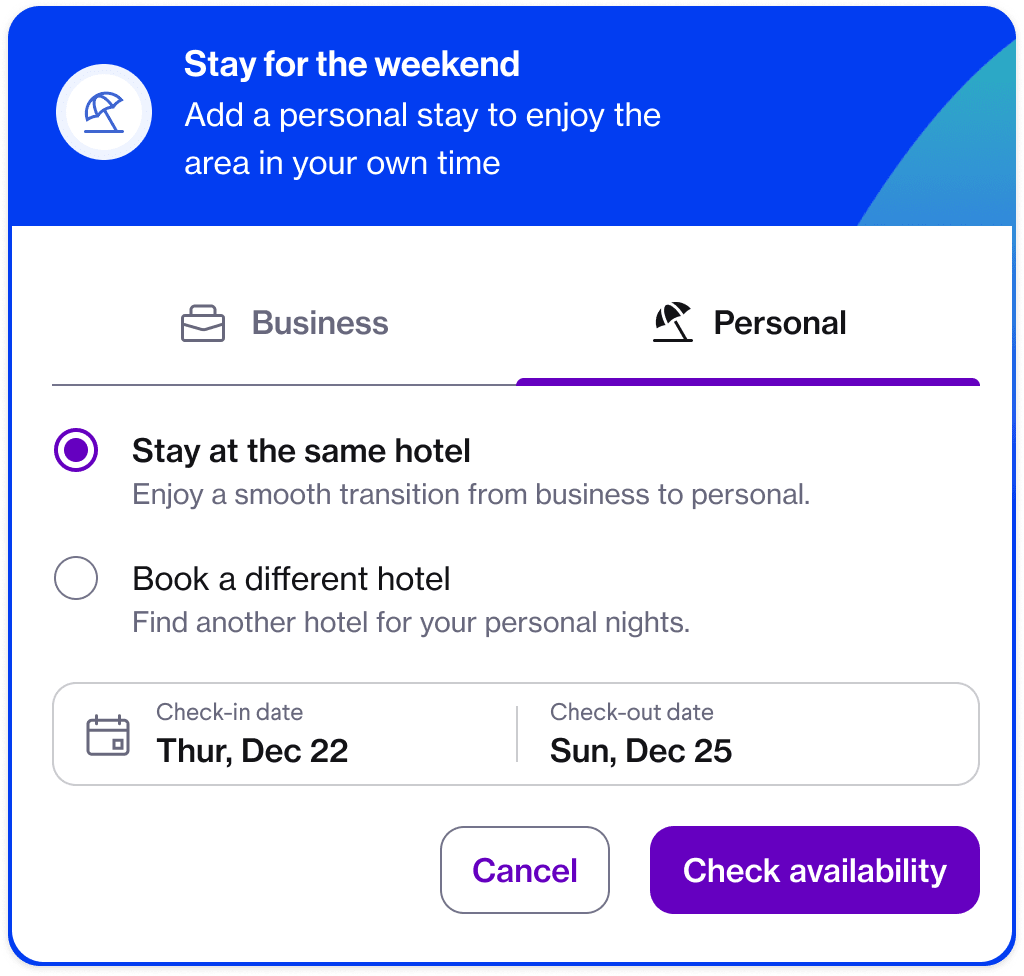
Above: Navan makes it simple for employees to add extra days to business trips while ensuring that the line between work and play is clear-cut. Because payment is processed with a personal credit card, the business and personal expenses are clearly delineated.
9. Build a Comprehensive but Flexible Complete Wellness Program
The most effective approach combines these strategies into a cohesive travel program rather than scattered initiatives. Organizations that implement wellness-focused travel policies see improved compliance, enhanced employee health, and reduced turnover among frequent travelers.
A robust, flexible approach typically includes:
- Data‑driven monitoring of travel intensity, not just spend
- Flight and recovery policies that protect well‑being for long or complex trips
- Automation to minimize post‑trip administrative work
- Thoughtful hotel and itinerary guidelines that support sleep, nutrition, and movement
- Manager enablement, so leaders know how to use the available data and policies to protect their teams
Flexibility matters because burnout manifests differently across individuals. Some employees thrive with high-frequency travel when supported by loyalty benefits, mental health resources, and recovery time. Others need more control over scheduling and accommodations.
Technology platforms — Navan among them — can help by centralizing bookings, surfacing well‑being indicators like nights away and red‑eye usage, and simplifying expenses. But the core of burnout prevention is policy design, leadership behavior, and a clear message that traveler well‑being matters as much as trip volume.
Your HR systems and travel policies, in sync
Navan integrates with 30+ HRIS platforms, including Workday, BambooHR, and ADP. When you update an employee's department or cost center, their travel policies update automatically.
FAQs About Business Travel Burnout
This content is for informational purposes only. It doesn't necessarily reflect the views of Navan and should not be construed as legal, tax, benefits, financial, accounting, or other advice. If you need specific advice for your business, please consult with an expert, as rules and regulations change regularly.